

Let the machines argue. Keep the verdict
How to fight "prêt à penser"
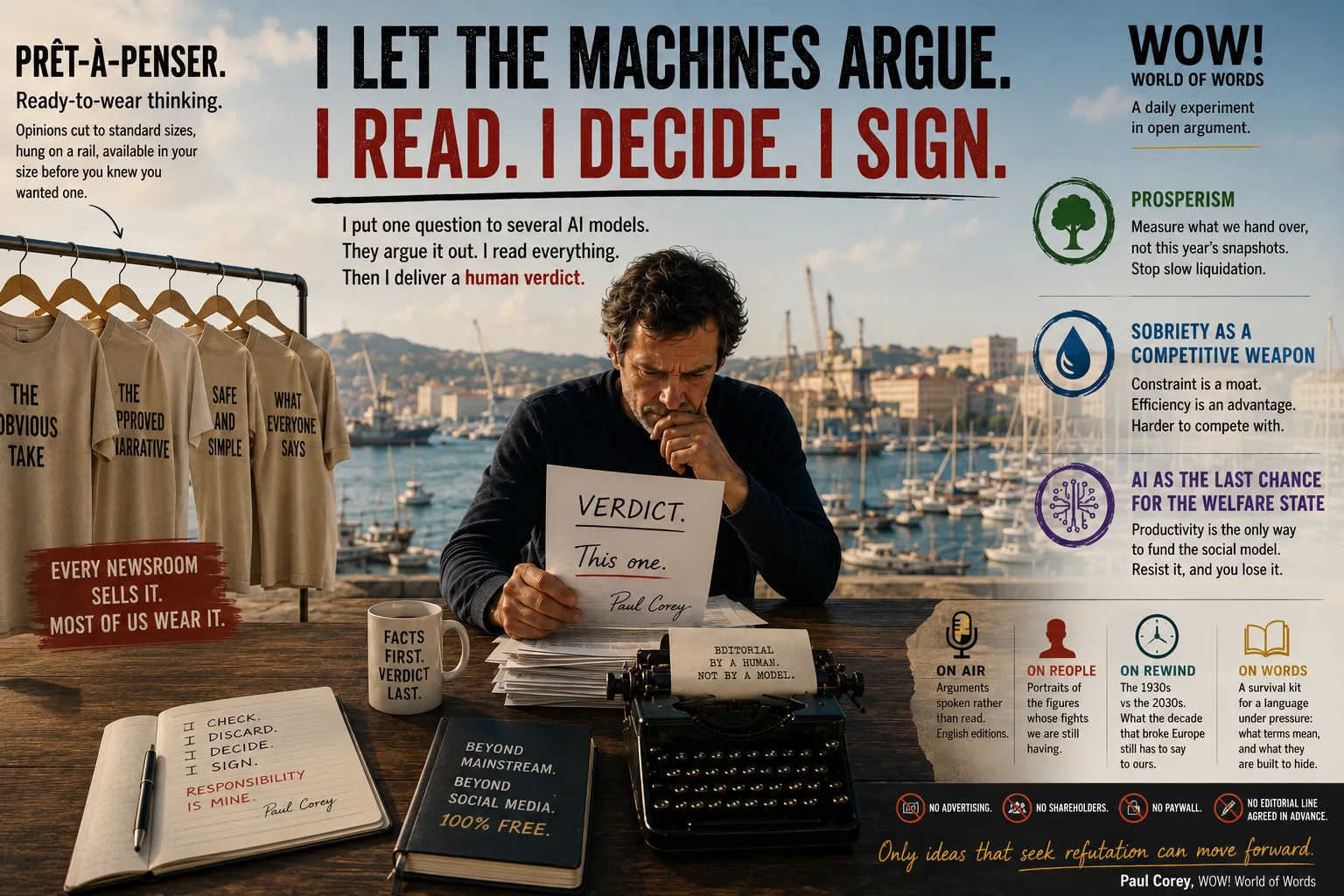
There is a French phrase with no clean English equivalent: prêt-à-penser. Ready-to-wear thinking.
Opinions cut to standard sizes, hung on a rail, available in your size before you knew you wanted one.
Every newsroom sells it. Most of us wear it.
For a year I have been running a small experiment, in France, from a harbour on the Mediterranean. It runs backwards from everything else.
Wherever AI has entered a newsroom, the arrangement is the same. The human supplies the opinion, the machine supplies the polish. Here it is reversed. The machines do the arguing. Several of them, set against each other on the same question, until the disagreement becomes intriguing. They bring the facts, the figures, the international comparisons, and three or four positions that cannot all be true. Then I read the pile and decide. That is the entire publication.
The editorial that lands each morning is not a machine-assisted text. It is the opposite: a human verdict on machine-made arguments. What you are reading is the one thing in the process that no model produced. The moment somebody looked at plausible answers and said “this one”.
Is it a gimmick ? Ask the same question to different models and you get various answers. Change two words in your prompt and you can flip any of them. Most people treat that as the technology’s great embarrassment. But it is most useful.
A machine that argues every side with equal conviction is a perfect sparring partner and a terrible oracle.
Confusing the two is common mistake. Used as an oracle, it launders consensus and calls it research. Used as an opponent, it does something no newsroom can afford: it produces the strongest possible version of the argument you were hoping to avoid.
What does that produce ?
A few of the arguments I have ended up defending, none of which I held before the machines forced the questions include:
Prosperism. Governments are judged on growth, deficits, and unemployment, all of them snapshots. None is judged on the only number that matters to the people who come after us: the net worth of the country handed over to the next generation. Measure that instead, and almost every “responsible” budget of the last thirty years turns out to have been a slow liquidation.
Sobriety as a competitive weapon. Europe treats energy and resource restraint as penance, a moral tax on prosperity, sold with a straight face to people who did not vote for it. Run the numbers as an industrialist rather than a moralist and it inverts: the constraint is a moat. The economy that learns to produce the same output on a third of the input does not become poorer. It becomes very hard to compete with.
AI as the last chance for the welfare state, not its executioner. The standard European reflex is to see automation as the thing that will break the social model. The arithmetic says the reverse. A social model this expensive survives only through a productivity shock, and there is exactly one on offer. The countries that resist it hardest will be the ones that lose it first.
What else is here
The editorial lands every morning. Around it: On Air, the arguments spoken rather than read; On People, portraits of the figures whose fights we are still having; On Rewind, which sets the 1930s against the 2030s and asks what the decade that broke Europe still has to say to ours; and On Words, a survival kit for a language under pressure: what the terms in circulation actually mean, and what they are built to hide.
No advertising. No shareholders. No paywall. No editorial line agreed in advance with anyone, including myself.
Only ideas that seek refutation can move forward.
Paul Corey, WOW! World of Words
Paul Corey